 QTSurfer beta
A platform for quantitative strategies.
Create versioned Java strategies, validate your revisions, run historical backtests against exchange data, and explore parameters — with results you can inspect, compare, share, and reuse.
- Java strategies
- Historical backtests
- Parameter exploration
From Java source to a result you can question.
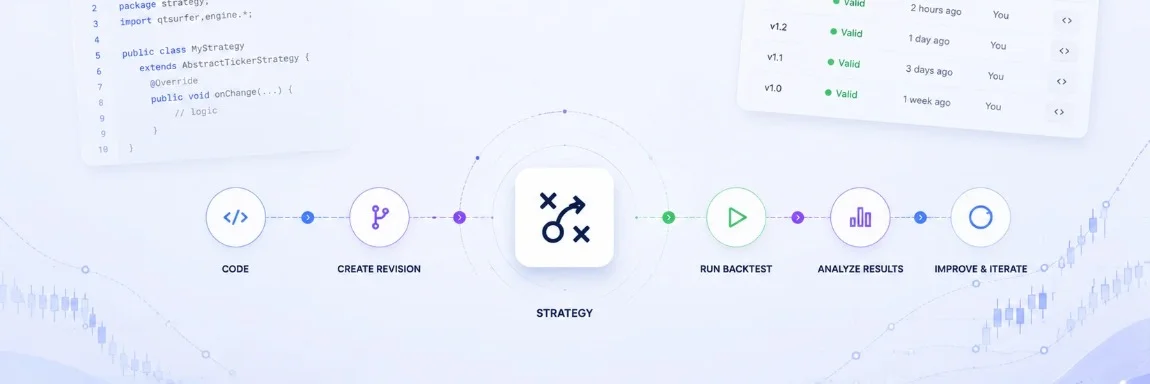
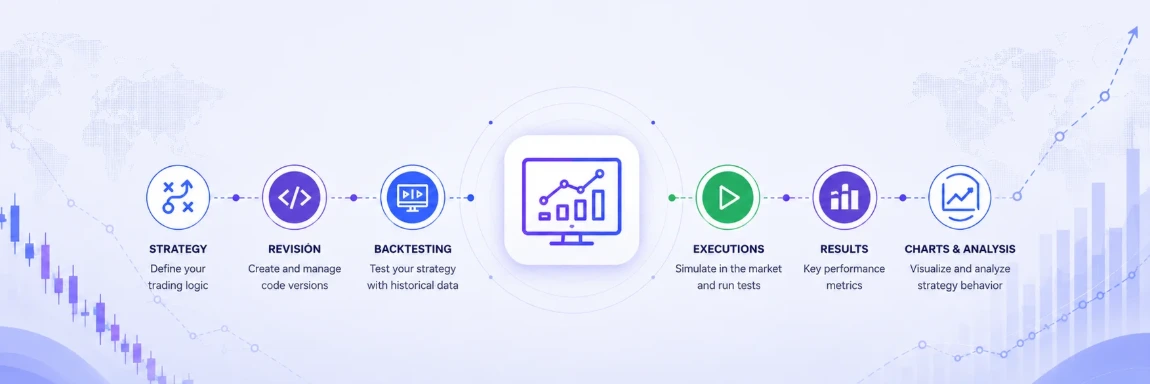
QTSurfer keeps the work together: author a strategy, validate a revision, run it on historical data, explore the execution space, and share what you learned.
Author
Write Java strategy source with examples, editing controls, and an AI-assisted starting point.
Validate
Compile and register a revision, with explicit validation states and errors attached to the version.
Backtest
Choose an exchange, instrument, date range, data cadence, and the assumptions behind the run.
Explore
Sweep numeric and boolean properties, rank executions, compare phases, and refine an experiment.
Share
Review a revision, publish it to the marketplace, or reuse a strategy in your own platform.
Keep the code, revision, and evidence connected.
Start from an idea, an AI-assisted prompt, or a working example. Write Java in the editor, compile it against the strategy API, and keep every meaningful change as a new revision.
Make the assumptions visible.
Configure the market-data slice and simulated execution rules before the run starts. Queued jobs report progress, status, cancellation, and results.
Results can include an equity curve, PnL, trade count, win rate, Sharpe, Sortino, CAGR, max drawdown, execution groups, notices, and runtime details.
Validate a revision, then explore its range.
QTSurfer separates a reproducible historical run from parameter exploration. That makes it easier to understand whether you are checking one idea or comparing many configurations.
Historical backtest
Run one strategy revision against an exchange, selected instruments, a historical window, a data cadence, and explicit capital and cost assumptions.
Simulated backtest
Sweep numeric and boolean properties, choose a sampling method, split the experiment, compare phases, and refine a study without treating the ranking as a promise.
Test a range, not a single guess.
Simulated backtests can sweep strategy properties through Cartesian, Latin Hypercube Sampling, or Monte Carlo modes where the execution space and plan allow it.
Rank executions across numeric and boolean parameter combinations.
Compare results by phase, with leaderboards and sensitivity views.
Refine a result into another phase without treating exploration as a profitability promise.
Compare the runs, not just the headline number.
Inspect aggregate metrics, rank groups by a chosen objective, select curves to compare, and open the execution behind a result. The detail matters as much as the score.
Useful context around the strategy.
Laboratory
Start with a visual idea before committing to Java. Select one fixed market-data slice, compose logic in the Studio, inspect the resulting signals, and carry a promising experiment into a written strategy.
Read the Laboratory guideMarketplace
Publish strategy revisions, set access controls, react to listings, and reuse strategies in your own platform.
Exchange and instrument data
Inspect the configured exchange inventory, instruments, coverage, ticker context, and market-data settings.
QTSurfer currently focuses on strategy authoring, validation, historical simulation, results, and reuse. Live order execution, portfolio tracking, and deployment are not represented as shipped capabilities here.
Notify me when we launch.
The private beta invitation covers the strategy platform: Java authoring, validation, historical backtests, parameter exploration, result inspection, and strategy reuse. Leave your email and exchange so we can route the invitation.