 QTSurfer beta
Equity curves
Transform, retain, retrieve, and plot backtest and sweep equity curves.
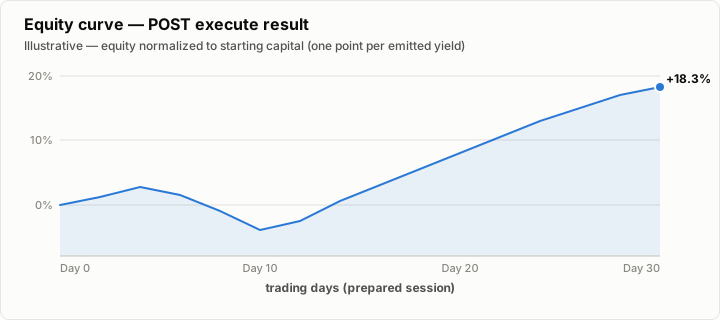
An equity curve describes the account value through a backtest. QTSurfer returns the same EquityCurveResult contract for a plain backtest and for a retained sweep trial, with different
delivery rules:
- A plain backtest returns the curve inline in
results.equityCurveand fixes its transform when the execution is submitted. - A sweep row with a retained curve carries
equityCurve.url. In the materialisation view (?order=natural) it can also include the curve inline; fetch its URL to choose a different transform at read time.
The first point is an anchor at the backtest from timestamp with the initial capital. Every later
point is one sample per emitted yield. equity is account value (initialCapital + cumulativePnl),
not a percentage. To chart percentage return, normalize each value as (equity / initialEquity - 1) * 100.
Response shapes
meta.outMode determines which point representation is present.
ARRAY
{
  "points": [
    {"timestamp": 1700000000000, "equity": 100.0},
    {"timestamp": 1700000060000, "equity": 110.5},
    {"timestamp": 1700000120000, "equity": 90.25}
  ],
  "meta": {
    "inputPointCount": 3,
    "outputPointCount": 3,
    "resampled": false,
    "differential": false,
    "outMode": "ARRAY"
  }
}
SHORT
SHORT removes repeated JSON property names by returning parallel arrays. Values at the same index
form one point.
{
  "timestamps": [1700000000000, 1700000060000, 1700000120000],
  "equities": [100.0, 110.5, 90.25],
  "meta": {
    "inputPointCount": 3,
    "outputPointCount": 3,
    "resampled": false,
    "differential": false,
    "outMode": "SHORT"
  }
}
Do not infer the shape from the request. A server size guard may force a compact representation; meta.outMode is the source of truth.
Transform pipeline
Transforms run in a fixed order: resample → differential → outMode.
| Option | Type and default | Effect |
|---|---|---|
resample | integer ≥ 2; omitted | Limits the result to at most this many points. Downsampling preserves the exact first and last points and global extrema. A ceiling above the input size is a valid no-op. |
differential | boolean; false | Keeps the first post-resample point absolute and delta-encodes timestamp and equity from the second point onward. |
outMode | ARRAY | SHORT; ARRAY | Chooses objects or parallel arrays after the preceding stages. |
The response metadata reports what actually happened:
| Metadata | Meaning |
|---|---|
inputPointCount | Number of points received by the transform pipeline. |
outputPointCount | Number of points after the complete pipeline. |
resampled | true only when resampling changed the point count. |
differential | true only when delta encoding ran; a zero- or one-point curve has nothing to encode. |
outMode | Actual JSON representation served. |
Decoding differential data
The first point remains absolute. Reconstruct each following point by adding its delta to the previous reconstructed value:
{
  "timestamps": [1700000000000, 60000, 60000],
  "equities": [100.0, 10.5, -20.25],
  "meta": {
    "inputPointCount": 3,
    "outputPointCount": 3,
    "resampled": false,
    "differential": true,
    "outMode": "SHORT"
  }
}
This reconstructs timestamps 1700000000000, 1700000060000, 1700000120000 and equities 100.0, 110.5, 90.25. The same rule applies to points in ARRAY mode.
Plain backtests: choose the transform on submit
A plain execution has no later curve endpoint, so its transform is baked into the stored result.
Set equityCurve on POST .../execute:
curl -X POST https://api.qtsurfer.net/v1/backtest/binance/ticker/execute
  -H "Authorization: Bearer $TOKEN"
  -H "Content-Type: application/json"
  -d '{
    "prepareJobId": "5ikYAMIO...",
    "strategyId": "2ul144qe9tlwzu5anhwvc6",
    "equityCurve": {"resample": 500, "differential": true, "outMode": "SHORT"}
  }'
Omitting equityCurve means ARRAY, no requested resampling, and no differential encoding. The
transform participates in execution idempotency: (prepareJobId, strategyId, storeSignals, equityCurve) → jobId. Changing only the transform creates
a different execution rather than reshaping an existing result.
The curve is present with yield metrics after the strategy emits at least one trade. For indicator
values and buy/sell markers behind the aggregate curve, request stored signals and read the Parquet
file at signalsUrl.
Sweeps: select, retain, and fetch curves
Sweep rows are aggregate outcomes and do not carry time series by default. EquityCurveRequest adds retention controls to the shared transform options:
| Field | Type and default | Effect |
|---|---|---|
mode | auto | topN | topPct | none; auto | Chooses which completed trials retain curves. auto delegates retention to server size limits; use topN or topPct when deterministic retention is required. |
n | integer ≥ 1 | Number of ranked trials retained by topN. |
maxPct | number > 0 and ≤ 100 | Percentage of ranked trials retained by topPct, rounded up with a minimum of one. |
resample, differential, outMode | shared options | Defaults used when a later curve GET omits its corresponding query parameter. They do not affect retention. |
{
  "strategyId": "2ul144qe9tlwzu5anhwvc6",
  "sweep": {
    "sampler": "grid",
    "objective": "sharpe",
    "params": {"rsiPeriod": {"from": 7, "to": 28, "step": 1}}
  },
  "equityCurve": {
    "mode": "topN",
    "n": 5,
    "resample": 500,
    "outMode": "SHORT"
  }
}
Retention (mode, n, maxPct) contributes to sweep identity. Transform defaults do not: two
otherwise identical submissions that differ only in resample, differential, or outMode deduplicate to the same sweepId.
With topN or topPct, every completed run that produced trades retains a curve. equityCurve is
absent, not null, only when a run aborted, it produced no trades, or the sweep requested no
retention (mode: auto or none). Selection changes delivery rather than whether a curve exists:
the ranked view carries a pointer, while the materialisation view (?order=natural) can carry the
same pointer together with inline points.
For example, a ranked row can contain a pointer:
{
  "runIx": 12,
  "equityCurve": {
    "meta": {
      "inputPointCount": 118,
      "outputPointCount": 118,
      "resampled": false,
      "differential": false,
      "outMode": "ARRAY"
    },
    "url": "/v1/backtest/binance/ticker/executeSweep/5ikYAMIO.../swp_95e47a7f0966ce11/runs/12/equityCurve"
  }
}
Do not use the presence of equityCurve, or the absence of url, to determine whether a curve is
inline. Both are misleading: a pointer-only row has equityCurve, and an inline curve keeps url so it can be fetched again with a different transform. Read points or equities instead.
When a row carries only a pointer, fetch url for the actual, possibly size-guarded curve and
authoritative metadata. The row metadata may be a declaration rather than a measurement: on a
non-promoted curve its point count is derived from the trade count rather than read from storage.
Sweep curve query parameters
GET .../runs/{runIx}/equityCurve accepts outMode, resample, and differential. A parameter
omitted from the query inherits the sweep submission’s transform default. An explicitly supplied
value overrides that default for this read:
curl "https://api.qtsurfer.net$EQUITY_CURVE_URL?outMode=SHORT&resample=500&differential=true"
  -H "Authorization: Bearer $TOKEN"
The server may still force a smaller representation above its size thresholds. Parse the response
according to meta, not according to the submitted defaults or query string.
The endpoint returns 404 when the sweep or runIx is unknown, or when that trial has no retained
curve. Those cases are intentionally indistinguishable to the caller.
Without a retained sweep curve, reproduce the chosen trial with params on a plain execute — pass the row’s winning parameter values and
the same prepareJobId, no recompile needed. This is an independent execution, not a replay of the
sweep trial, but the two paths are pinned to agree on every leaderboard metric for the same vector.
Treat a difference as a bug worth reporting.